

Overview of Implant Placement
The Dental Implant Surgical Procedure
The procedure to place a dental implant varies depending on the number of implants and the complexity of your treatment. Placement may take approximately 30 to 60 minutes for one implant, while multiple implants require additional time. The number of appointments and time required vary from patient to patient. Dr. Strickland will explain the planned procedure and anticipated timing during your consultation.
Prior to surgery, you may receive antibiotics if indicated. Options for greater comfort, such as intravenous sedation or nitrous oxide (laughing gas), will be discussed at your consultation. A local anesthetic will be administered to numb the area where the dental implant will be placed.
Once the area is numb, Dr. Strickland makes an opening in the gum tissue, prepares a space in the bone using specialized instruments, and places the implant. Depending on your treatment plan, a healing component may remain visible above the gum, or the implant may be covered by gum tissue during the initial healing period.
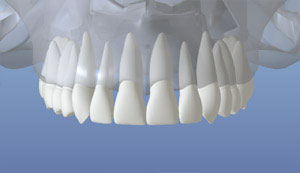
1. Normal
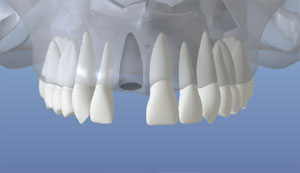
2. Tooth Loss
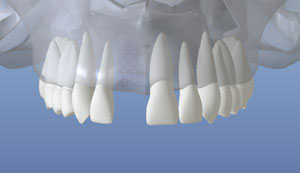
3. Healed Bone
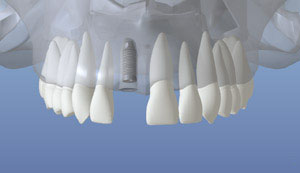
4. Implant Placed
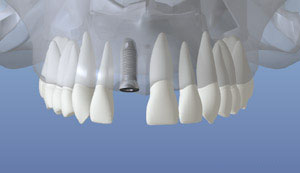
5. Healing
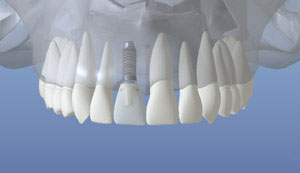
6. Implant Restored
Healing After Dental Implant Surgery
After placement, the implants begin integrating with the surrounding bone. Healing time varies depending on factors such as bone quality, the treatment performed, and your individual health. In selected cases, a temporary restoration may be attached soon after implant placement. Dr. Strickland will advise you on follow-up care and the appropriate timing for your restoration.
Depending on the approach used, a healing cap or an abutment (support post) may be placed at the initial procedure or during a later visit. These components help shape the surrounding gum tissue or connect the implant to the replacement teeth.
Occasionally, digital impressions are made at the time the implant or implants are placed. This allows planning and fabrication of the crown or other restoration to begin while healing progresses. The timing of the final restoration depends on appropriate implant integration and the needs of your treatment plan. Follow-up care, usually involving one to four appointments, helps Dr. Strickland assess whether the implants are integrating appropriately and determine when you are ready for the restorative phase of treatment.
In some cases, a soft tissue graft may be recommended to improve the gum tissue around an implant. Dr. Strickland will explain whether this would be beneficial and what the procedure involves.
Whether you are replacing one tooth, several teeth, or a full arch, the restorative phase involves fitting the appropriate replacement teeth to your implants. Your restoration may be an individual crown, an implant-supported bridge, or a full-arch restoration.
Dental Implants Presentation
To provide you with a better understanding of dental implants, we have provided the following multimedia presentation. Many common questions pertaining to dental implants are discussed.

When Are Dental Implants Placed?
Implants may be placed after an extraction site has healed or, in suitable cases, immediately following extraction of a tooth. The appropriate timing depends on the condition of the site, available bone, and the ability to achieve implant stability. Dr. Strickland will recommend an approach based on your individual needs.
After tooth loss, the surrounding jawbone can gradually shrink. If there is insufficient bone to support an implant, bone grafting may be recommended before or at the time of implant placement.
Multiple Implants: How Many Do I Need?
The number of implants depends on how many teeth are being replaced, the available bone, and the type of restoration planned. You do not necessarily need one implant for every missing tooth.
- One Missing Tooth: A single implant can support an individual crown.
- Several Missing Teeth: Multiple implants may support a bridge that replaces several teeth.
- A Full Arch of Missing Teeth: Several strategically placed implants can support a full-arch restoration, such as an All-on-X bridge or an implant-retained denture.
Dr. Strickland will evaluate your oral health, review your imaging, and discuss your goals to recommend the number and placement of implants appropriate for your treatment.
